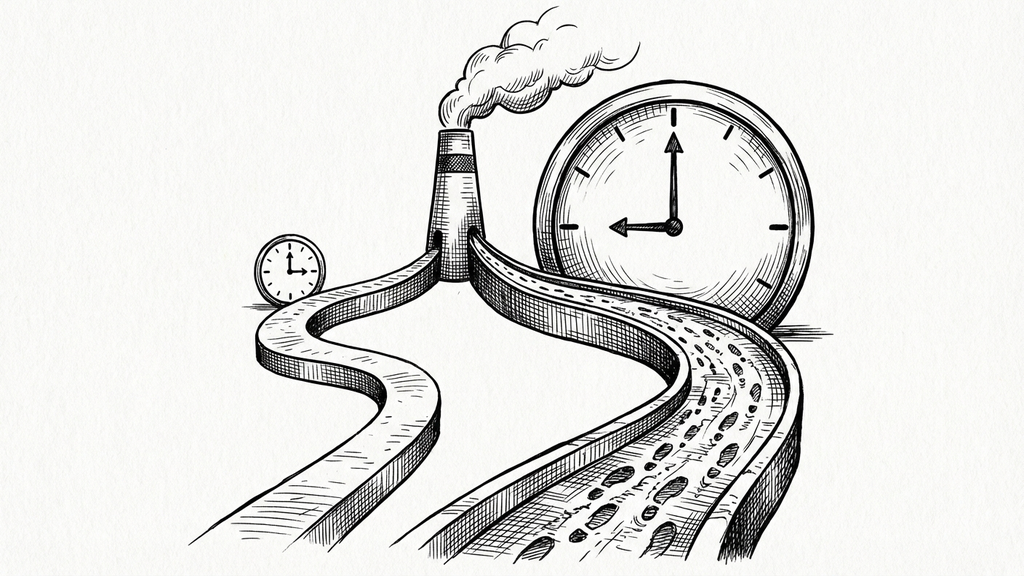
In 1865, William Stanley Jevons published The Coal Question and noticed something that nobody wanted to hear. James Watt’s steam engine had made coal use far more efficient. The reasonable expectation was that Britain would burn less coal. The opposite happened. Efficiency made coal-powered industry viable in places it hadn’t been before, and consumption exploded.
Jevons didn’t mince words: “It is wholly a confusion of ideas to suppose that the economical use of fuel is equivalent to a diminished consumption. The very contrary is the truth.”
He wasn’t just talking about coal. In the same book, he noted that labor-saving machinery “throws labourers out of employment for the moment. But such is the increased demand for the cheapened products, that eventually the sphere of employment is greatly widened.” More efficiency, more work. Not less.
I’ve been thinking about this a lot since reading Roberto Seghetti’s piece in Appunti, where he documents something that shouldn’t surprise anyone familiar with Jevons, but somehow still does: in 2026, in the age of AI, multiple governments are actively legislating longer working hours.
The promise
In February 2025, Bill Gates went on The Tonight Show and predicted that AI would shrink the workweek to just two days within a decade. Humans, he said, “won’t be needed for most things.”
Sam Altman has been saying variations of this for years. At DevDay 2025, he described most current jobs as “not real work,” comparing modern office workers to farmers who would view what we do as barely labor. He’s even referenced Keynes, saying he’s “still waiting for that promise from the industrial revolution that we only had to work four hours a week.”
About that. In 1930, John Maynard Keynes wrote “Economic Possibilities for our Grandchildren” and predicted that by approximately 2030, a fifteen-hour workweek would suffice. “Three-hour shifts or a fifteen-hour week may put off the problem for a great while,” he wrote. “For three hours a day is quite enough to satisfy the old Adam in most of us!”
We are now four years from his target date. The OECD average is about 37 hours per week. He was off by a factor of 2.5.
Here’s the thing: Keynes was right about productivity. Western economies are 5-8x more productive per hour than in 1930, roughly in line with his prediction. The output side of his equation held up. The hours side didn’t. Nicholas Crafts analyzed this gap in a 2022 paper in Economica and concluded that people chose more consumption over more leisure, that relative status drives spending more than absolute comfort, and that work itself became entangled with identity.
A 2024 reappraisal by the US Bureau of Labor Statistics reached the same conclusion: productivity gains were captured as output, not as free time.
The reversal
While Gates and Altman promise a world with less work, here’s what’s actually happening. The drivers differ (demographics in Germany, austerity in Argentina, race dynamics in AI, catch-up economics in India), but the direction is the same.
Germany. The CDU-SPD coalition agreement of April 2025 proposes replacing the daily eight-hour cap (Section 3, Arbeitszeitgesetz) with a weekly maximum, aligned with the EU Working Time Directive’s 48-hour ceiling. The practical effect: individual days can stretch well beyond ten hours, as long as the weekly average holds. The Hugo-Sinzheimer-Institute has noted that twelve-hour days become legally possible under this framework. Chancellor Merz promised legislative proposals by spring 2026.
Argentina. On February 20, 2026, the Chamber of Deputies approved a labor reform bill (135-115) allowing twelve-hour workdays with a minimum twelve-hour rest between shifts, replacing paid overtime with an “hour bank” system where extra hours are compensated with time off instead of money. The bill also restricts strike rights and fragments vacation entitlement. A nationwide general strike preceded the vote. The bill still needs Senate re-approval.
Silicon Valley. Fortune reported in August 2025 that Bay Area AI startups are adopting China’s 996 model: nine to nine, six days a week, 72 hours. NPR followed up in October, documenting how 996 “is capturing the interest of Silicon Valley leadership.” This is the same schedule that China’s Supreme People’s Court declared illegal in August 2021. Paolo Benanti, writing in Il Sole 24 Ore, warned that tech companies are shifting from a culture of employee pampering to one where humans become “the perfect sensor” of machines. In February 2025, Sergey Brin’s leaked memo to Google’s Gemini team called 60 hours a week the “sweet spot.”
India. In October 2023, Infosys co-founder NR Narayana Murthy urged young Indians to work 70 hours a week “for the country.” ILO data shows Indians already average 46.7-47.7 hours per week, ranking sixth globally. Over 51% of Indian employees already work 49+ hours. Murthy was asking for a 50% increase on top of that.
Why it keeps happening
The pattern is not new. Working hours dropped dramatically between 1870 and 1970, from roughly 3,000 hours per year to under 1,800 in most OECD countries. But that decline wasn’t caused by technology. It was caused by organized labor: Robert Owen in 1817, the Illinois eight-hour law of 1867, Henry Ford’s 40-hour week in 1926, the Fair Labor Standards Act of 1938.
Then the decline stalled. Since roughly 1980, despite the PC revolution, the internet, smartphones, and now AI, average working hours in developed economies have been essentially flat. The OECD data shows this clearly: the long decline ended, and the line went horizontal.
What changed? Not the technology. The technology kept getting better. What changed was the balance of power. Union membership peaked in the 1970s and has been falling ever since. The Economic Policy Institute has documented how the OECD’s 1994 Jobs Strategy reframed “flexibility” as an economic virtue, when in practice it meant weakening the protections that had shortened the workweek. The EU Working Time Directive caps hours at 48 per week, but Article 22 allows individual opt-out, and the European Trade Union Confederation has argued since 1993 that the opt-out has been “widely abused.”
Yes, there are counter-examples. The UK’s 4-Day Week pilot showed positive results. Iceland ran successful trials. But these are happening in high-margin knowledge sectors with strong institutional backing, and they remain exceptions. The broader legislative and corporate trend is moving the other way.
Jevons would recognize this immediately. Efficiency doesn’t reduce consumption. It reduces the cost per unit, which increases demand. When you make labor more productive, you don’t get shorter days. You get more ambitious targets.
The AI chapter
If you’ve been reading this series, you already know how this maps onto AI-assisted work. In January, I wrote about the AI Productivity Paradox: the METR study showing experienced developers were 19% slower with AI, while believing they were 20% faster. Two days ago, I wrote about how AI didn’t reduce my cognitive load, it transformed it. I write less code and arrive more exhausted.
More evidence keeps piling up. In February 2026, Ranganathan and Ye at Berkeley Haas published “AI Doesn’t Reduce Work, It Intensifies It” in the Harvard Business Review. Their eight-month ethnographic study of 200 tech workers identified three mechanisms:
| Mechanism | What happens |
|---|---|
| Scope expansion | Workers take on tasks that previously belonged to others or wouldn’t have been attempted |
| Temporal seepage | Work seeps into pauses: lunch, before meetings, evenings, via AI prompts |
| Multitasking amplification | Running AI processes in background while doing other work |
CEPR/VoxEU published a piece titled “As AI’s power grows, so does our workday.” Scientific American covered why developers using AI are working longer hours. Simon Willison’s observation captures it perfectly: “I can get SO much done, but after just an hour or two my mental energy for the day feels almost entirely depleted.”
The pattern holds even when you look at jobs instead of hours. Alfonso Fuggetta pointed out that while Anthropic’s study on AI labor exposure triggered waves of doomsday commentary, Wall Street Journal data shows software engineering job postings actually growing. Fuggetta arrived at Jevons independently: efficiency gains lower costs, which expands markets, which creates more work. The same paradox, from a different dataset.
To be fair: a Fortune/LSE study of 7,000 workplaces found no significant impact on earnings or recorded hours in any occupation. Which, if you think about it, supports the argument from a different angle: even in the best case, AI isn’t delivering the shorter workweeks we were promised. The range of outcomes runs from “no change” to “intensification.” Nobody is finding a reduction.
Italy’s hidden dimension
The Jevons Paradox has a distributional dimension that the original formulation misses: when working hours increase, they don’t increase equally for everyone. There’s a piece of this story that doesn’t make it into English-language coverage. ISTAT’s April 2025 report “Donne al lavoro” shows that 15.6% of employed Italian women aged 25-64 are in involuntary part-time, compared to 5.1% of men. Three times the rate. Over 60% of part-time women would work full-time if they could. The employment rate for mothers aged 25-54 is 62.3%, versus 91.5% for fathers.
The cause isn’t preference. It’s infrastructure: insufficient nurseries, inadequate elder care, a welfare system that assumes someone (a woman) is at home. Italy’s gender employment gap (19.4%) is nearly double the EU average.
The automation promise was supposed to help here too. Machines would handle the drudge work, and everyone would get more time and flexibility. Instead, the “flexibility” in the new labor reforms means employers can demand twelve-hour days, while the care infrastructure that would allow women to participate fully in the workforce remains missing.
What Jevons tells us
Here is what I think the pattern says, stripped down.
Technology doesn’t determine how we work. It determines what’s possible. What actually happens depends on who controls the terms. The steam engine could have meant shorter days. It meant child labor in factories. The eight-hour day required half a century of strikes, legislation, and political organization.
Every wave of automation comes with the same promise: this time, the machines will set you free. And every time, the gains flow to whoever has leverage. Jevons saw it in 1865. Keynes got the productivity half right and the hours half wrong because he assumed the gains would be shared. The BLS reappraisal puts it plainly: productivity gains were captured as output, not as free time.
AI is the latest iteration. It makes work cheaper per unit, which increases the demand for work. It makes individuals more productive, which raises the bar for what’s expected. And it arrives in an era where the institutions that historically converted productivity gains into shorter hours (unions, labor regulation, social safety nets) are weaker than they’ve been in a century.
Gates promises a two-day workweek. Merz is drafting twelve-hour days. Both are responding to the same technology. The difference is who benefits.
Methodology note
This article was written with AI assistance (Claude Code for research gathering and drafting, Gemini for review). The working-hours paradox applied to its own creation: it took about two hours of concentrated AI-mediated work, which felt like four. The research was verified against primary sources. All citations link to original publications. The Jevons quote was checked against the Online Library of Liberty edition.
Acknowledgments
Roberto Seghetti’s piece in Appunti was the catalyst. The Jevons Paradox framing builds on an earlier clipping about the Abstraction Rises pattern. The Berkeley Haas study by Aruna Ranganathan and Katherine Ye provided the central evidence on AI work intensification.
Sources
- Jevons, W.S. - The Coal Question (1865) - Original text, Online Library of Liberty
- Keynes, J.M. - Economic Possibilities for our Grandchildren (1930) - Yale Economics
- Crafts, N.F. - The 15-Hour Week: Keynes’s Prediction Revisited (2022) - Economica
- BLS - A Reappraisal of Keynes (2024) - Monthly Labor Review
- Ranganathan & Ye - AI Doesn’t Reduce Work, It Intensifies It (2026) - Harvard Business Review
- METR - AI Developer Productivity Study (2025)
- OECD - Hours Worked - Average annual hours per worker
- Our World in Data - Working Hours - Historical dataset
- Littler - CDU Coalition Agreement 2025
- Al Jazeera - Argentina Labor Reform (Feb 2026)
- Fortune - Silicon Valley 996 (Aug 2025)
- NPR - 996 in Silicon Valley (Oct 2025)
- Fortune - Sergey Brin 60 Hours (Feb 2025)
- ISTAT - Donne al lavoro (Apr 2025)
- Fortune - Murthy 70 Hours (Oct 2023)
- Fortune/LSE - AI Impact on Hours (May 2025)
- EPI - Workers and the OECD Jobs Strategy
- CEPR - As AI’s Power Grows, So Does Our Workday
- Scientific American - Why Developers Using AI Work Longer Hours
- Fuggetta, A. - Non bisogna guardare le figure (Mar 2026) - A bassa voce