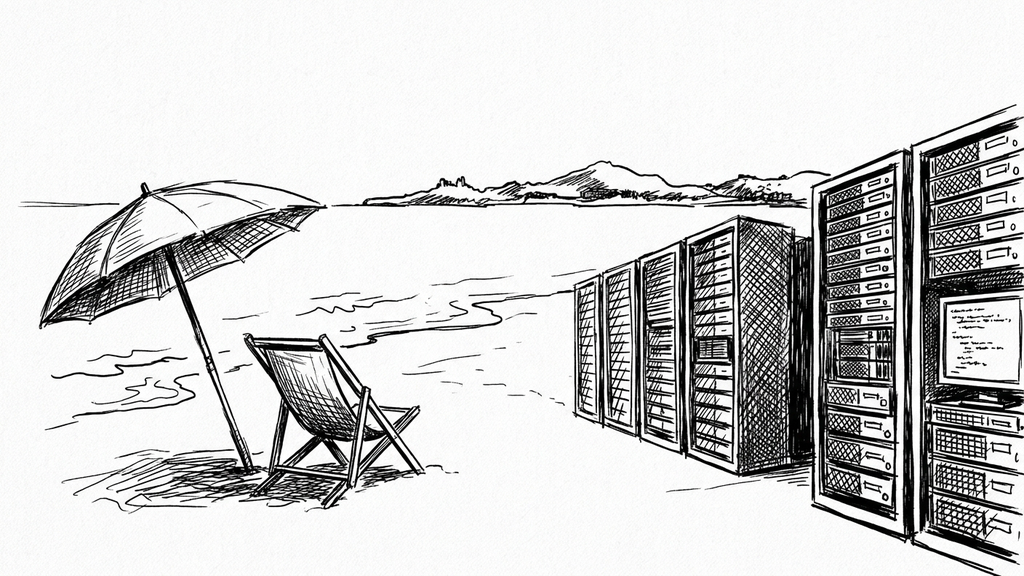
A post popped up on my Facebook feed this morning, the kind that goes viral instantly. It is about Sardinia’s economy, it is genuinely well written, but it left me with a mix of numbers and a certain frustration that I cannot quite shake off. I agree with almost every line. It is only at the conclusion that our paths diverge.
If we set aside petroleum and its derivatives, the number-one “product” we export to the rest of the world is not pecorino, not wine, and not chemicals. It is a foreign tourist’s holiday. In 2024, according to Bank of Italy data, foreign visitors spent about 1.85 billion euros in Sardinia. To put that into perspective, let’s compare it with what the island actually ships in containers (excluding oil): agri-food exports account for about 250 million, metals around 230 million, chemicals under 200 million, and wine is just a tiny fraction of that. If you add up every other non-petroleum sector, following the CRENoS export breakdown, the island’s entire export base remains below 1.2 billion euros. This means foreign tourism, on its own, weighs more than all of them combined. Of course, comparing tourist spending to the value of physical goods crossing a customs line is not a perfect comparison (gross spending is not net value added). But I am doing it anyway. In both cases, Sardinia is selling something to the world, and one of these categories is worth more than all the others combined. It is our primary export, and it arrives every summer in euros, by plane or ferry.
As a Sardinian, reading this does not fill me with pride; it makes me anxious. This is not good news, but rather a warning sign we need to examine closely, even if such a figure can be interpreted in two completely opposite ways (and in this case, it probably is).
Two lenses, two truths
Tourism is simultaneously our superstar and our tail-ender. It all depends on how you measure it.
If we look at the balance of payments (how much foreign currency enters the local economy), tourism wins handily. But if we look at productivity (the value generated by each individual worker), we drop to the bottom of the table.
The 2023 ISTAT data from the Tourism Satellite Account highlights this gap. Across Italian tourism enterprises, labor productivity is about 99,000 euros per worker (30% below the national average) and the average wage is 17,709 euros (35% below). If we narrow our focus to accommodation alone, the area where Sardinia is strongest, value added per worker falls to around 44,000 euros, compared to about 82,000 euros for our international competitors (according to data from the Ministry of Enterprise and Made in Italy). To be clear: the 99,000 euro figure refers to the entire tourism sector, while the 44,000 euro figure only covers lodging. Furthermore, there are two factors to consider: these are national averages, and Sardinian tourism is far more seasonal and accommodation-heavy than the rest of Italy. This means the local situation is almost certainly worse. We are not just less productive compared to other industries; we are less productive even than our direct competitors in the very field where we collect the most revenue.
Honestly, I would have preferred to read that Sardinia exports 1.8 billion euros in software and telecommunications. A billion in beds is not the same as a billion in software. Both represent real money, but they build radically different economic foundations beneath them.
What the theory says (without being fans)
No trials for deck chairs: low productivity does not mean we should pack up and go home. We have specialized where we have an obvious competitive advantage (the sea, the climate, the nature), and it makes perfect sense. It would be absurd to ask Sardinia to apologize for the beauty of its coastline.
A strong tourism sector is not a problem in itself. A Bank of Italy study (Bronzini, Ciani, and Montaruli, Regional Studies 2022) calculated the impact of foreign tourist spending on the growth of per capita value added in Italian provinces. The effect is positive, tangible, and is felt most in regions starting from a disadvantage, like ours.
The data does not say that tourism is poison. It says something more useful: the boost is real, but it is limited and tends to wear off once congestion thresholds are crossed. The issue is not that the tourist’s euro is a “bad euro”, but that a monoculture economy built on it has a very low ceiling and a single point of failure. Easier revenues risk crowding out more complex, long-term economic activities. This is a subtle displacement mechanism (a highly plausible hypothesis, rather than a scientifically proven fact): short-term rentals that drive up housing costs for residents, rapid returns that discourage riskier and slower technological investments, and public resources continuously drained to promote the next season instead of funding research.
Why it hurts more here
This structural weakness is felt more acutely in Sardinia than elsewhere because of our productive fabric. The 32nd CRENoS report shows that over 96% of our companies are micro-businesses, averaging 2.9 employees. These tiny enterprises absorb more than 60% of all jobs (compared to 38% in the Center-North). An economy composed almost entirely of three-person businesses lacks the financial and organizational capacity to make long-term bets. If we combine this with savage seasonality, where tourism flows are concentrated almost entirely in July and August, we are left with a workforce that is active for only a few months of the year and idle for the rest.
There is also a matter of economic positioning. It is true we have an extraordinary luxury segment, like the Costa Smeralda, which generates high value per worker. But this is an enclave of a few kilometers, whose profits often leave the island as soon as the summer lights fade, failing to lift the regional average. The bulk of our tourism is far more ordinary: homes, apartments, and short-term rentals, which is the fastest-growing segment (newly registered rentals rose by over 40% in a single year). The issue is not the format of the accommodation, but the absence of related services (such as dining, guides, structured experiences) that instead make the fortune of places like the Balearics or the French Riviera. Our beaches remain wild by choice. Sardinians like them that way, and so do I. But economically, it means selling an umbrella and two sunbeds for a few euros a day, whereas a competitor elsewhere sells a full day of services with lunch included. Excluding the golden enclave of luxury, the rest leans downward: few stable skills, extreme seasonality.
Optimists reply that this distributed model protects the territory: 44,000 families supplement their income by renting a second home, with no multinationals draining profits abroad. This is a valid and important point. That money stays within the local economy and directly supports family budgets. However, retaining a euro is very different from compounding it. A summer rental helps pay the mortgage, but it does not build skills, careers, or scalable assets. It is a rent that must be re-earned from scratch every year. Forty-three thousand small landlords will never create the conditions to pay an engineer’s salary, simply because that is not their job. Staying resilient is one thing; generating new wealth is another.
Structural data confirms this struggle. Sardinian GDP per capita is around 29,500 dollars (measured by the OECD) compared to a national average of 40,900. Spending on research and development is stalled at 182 euros per head, compared to 439 euros in Italy and 742 euros in Europe. We invest less than half the national average and a quarter of the European average in the single factor that actually drives productivity over time. Meanwhile, the people who could change things are leaving: Sardinia loses about 12 graduates per thousand inhabitants to emigration each year (the national average is below three), and Svimez counts ten thousand qualified young people aged 25 to 34 who have left the island recently.
The late 2025 Svimez report highlights the most alarming trend: in 2024, Sardinia’s economy grew by 0.9%, but only thanks to industry and construction. Services (the sector containing most tourism) shrank, in contrast to the rest of the Mezzogiorno. Software is classified under services too, so this is not a condemnation of tourism alone, but it shows that in a record-breaking season, tourism’s spillover effects failed to drive the real economy. The supply chain is so short that hotels and resorts often source goods and services outside the island, dispersing a large portion of the economic value generated.
The result is a low-value, highly seasonal monoculture, in a region that is losing its graduates and failing to invest in innovation. This is not a coastline to apologize for, but it is certainly a strategy to worry about.
An alternative we already know
Yet there is a part of this story that belongs to us deeply.
Sardinia was the cradle of Italy’s consumer Internet. In 1990, the CRS4 research center was established near Cagliari; in March 1994, it helped put L’Unione Sarda online, making it one of the first digital newspapers in Europe. Soon after, Nicola Grauso launched Video On Line, which quickly became the country’s leading internet access provider. In 1998, also in Cagliari, Renato Soru founded Tiscali. For several years, this island was, without any exaggeration, the most innovative hub in Italy for tech development.
We know how to make things happen. The harsher lesson, if anything, is about what comes next. Video On Line was acquired by Telecom Italia, and its gravity shifted to Milan. Tiscali rode the dot-com bubble to extraordinary heights, only to downsize over the following decades. We produced outstanding pioneers, but we failed to build a lasting industrial district. This is the core issue: starting projects was never our bottleneck. Keeping them here was.
And yet, the ecosystem is far from dead. The Net Value has been a certified incubator active in Cagliari since 2009. Moneyfarm, now a prominent international player in financial services, has its roots and offices in the city. Abinsula, founded in Sassari by engineers who chose to return home, exports embedded and automotive software worldwide (with over 60% of its revenues generated abroad). Recently, CDP Venture Capital chose Cagliari for Frontech, an acceleration program focused on frontier technologies and artificial intelligence. The pieces are all on the table. What we lack is the capacity to connect them into a structure that can outlast its individual founders.
How to intervene concretely
My proposal is not to scale back tourism. It would be foolish to shut down the island’s primary engine. The real question is how to channel a fraction of the value generated by this engine toward higher value-added sectors.
There is no idle public treasure waiting in regional accounts: the euro spent by a tourist goes directly to the hotelier, the local family renting their second home, or Ryanair. It is almost entirely private capital, and a substantial part leaves the island within days. Consequently, “reinvesting the surplus” is not a simple administrative directive. The actual levers are complex and deeply political: attracting large institutional investors (like CDP with Frontech) and planning land use to decide if the next coastal hectares should go to a resort or a technology park. These choices require political courage and long-term vision.
But even with capital available, the historical challenge remains: retaining that value. Tiscali did not suffer from a lack of funding, yet economic gravity eventually pulled the company toward large continental centers where talent and late-stage capital concentrate. A startup born in Cagliari that reaches a Series B funding round almost naturally finds itself with a headquarters in Milan or, more likely, London. Today, however, we have two new factors that change the dynamics. First is remote work: a twenty-five-year-old software engineer can work for a global enterprise and earn an international salary while living in Cagliari or Pula. This partially disarms the physical agglomeration trap. Second is the arrival of qualified external capital, such as CDP’s fund. The goal should no longer be to force a company to remain physically anchored to the island in defiance of market forces, but to ensure that the skills, the salaries, and a portion of the intellectual and corporate ownership remain here, even if the legal headquarters eventually relocates.
Value that compounds, value that passes
The post I started from concludes with an appeal: recognize tourism as our primary export and treat it accordingly in development policies. I share the premise (ignoring it is snobbery), but I reject the conclusion. I do not want tourism to be the horizon around which we design the future of this island. Without touching a single beach stand, I want us to build an economy with better prospects and wages alongside it, letting it grow until it becomes the most significant figure in our ledger.
There is a solid objection to this view, which is the strong argument of the original post: tourism cannot be outsourced (a beach does not move to Romania). Software, by contrast, tends by its nature to migrate, as shown by the stories of Video On Line and Tiscali. Why then chase a volatile sector and neglect a resource anchored to our coastlines? The answer is that it is not a mutually exclusive choice. A non-transferable asset with low value-added remains a structural cap on wages. The goal is not to bet everything on software hoping it defeats tourism, but to reject the idea that a sunbed on a beach is the peak of our collective ambition. Even a partial victory (a few solid companies staying, skills consolidating, professionals working for international clients from home) raises the overall wage floor, which has been stagnant for thirty years.
There is also an exceptional card we are not playing: attracting external talent. Combining an affordable cost of living with an extraordinary quality of life is a rare luxury in today’s world. Beyond encouraging the growth of local startups, we can position the island as a global hub for professionals and digital nomads. Cagliari already has an international dimension, and those who visit tend to fall in love with it. The basic infrastructure already exists, it simply needs to be leveraged. I am thinking of Sardegna Ricerche and the technology park in Pula that hosts CRS4: a campus immersed in greenery just steps from the sea. Few places in the world can offer such a work environment. It is an enormous competitive advantage that we manage like a tourist postcard rather than an industrial resource.
Mine is a personal preference, not a verdict. I prefer a thousand local startups, even if we must accept that only a very few will make it, over ten thousand new holiday homes. Not for the immediate economic return in summer (where second homes would win outright), but for the possibility of having stable work in winter, real career paths that do not require boarding a plane, and an economy less vulnerable to the weather and seasonal trends.
It is the same concept applied to Europe and technological sovereignty that I wrote about in Own the Whole Stack, Down to the Silicon, transposed to a regional scale. There, the fear was depending on other people’s technologies that can be deactivated with a click. Here, the issue is even deeper: a hotel room or a villa must be rented out again every season, starting from scratch each time. A solid technology company, however, compounds on itself, generates local economic spin-offs, and continues to produce wealth and skilled jobs long after the founders have moved on. It is not a conflict between value that stays and value that leaves, but between value that compounds and value that must be constantly chased.
The current gap is immense. Comparing a Sassari software house with ten million in revenue to a 1.85 billion tourism sector almost makes you smile. Reversing this ratio is the commitment of a generation, not a single financial maneuver, and we might not succeed. Yet the Sardinian tech ecosystem is showing unprecedented signs of life. We have already proven we can do great things from nothing: the Italian Internet was born here. Today, the challenge is less romantic but more crucial: building those silent infrastructures (stable capital, support services, real reasons to stay) that allow the next generation of innovators to grow and succeed at home.
Sources and further reading
- Bank of Italy, foreign tourism spending statistics (international tourism, balance of payments) - bancaditalia.it; Sardinia 2024 figure of ~1.85 billion euros via regional reporting
- ISTAT, “Conto satellite del turismo per l’Italia - Anno 2023” - labour productivity 99,015 euros (−30% vs national), per-capita income 17,709 euros (−35%)
- Value added per worker in Italian accommodation (~44,000 euros vs ~82,000 for competitors), Ministry of Enterprise and Made in Italy, via partitaiva.it
- Mario Holzner, “Tourism and Economic Development: The Beach Disease?” - Tourism Management, 2011; and Chao et al., tourism Dutch-disease model, 2006
- R. Bronzini, E. Ciani, F. Montaruli, “Tourism and local growth in Italy” - Regional Studies, vol. 56, no. 1 (2022), pp. 140-154; originally Bank of Italy QEF No. 509 (2019)
- CRENoS, 32nd Report on the Economy of Sardinia (2025) - micro-firms over 96%, 2.9 employees average, micro absorbing over 60% of jobs vs 38% in the Centre-North - crenos.unica.it
- R&D 182 euros per capita vs 439 (Italy) and 742 (EU), GDP per capita $29,504 vs $40,898, graduate emigration - CRENoS / OECD 2025, via Cagliari Today
- Svimez, 2025 Report - Sardinia +0.9% in 2024 driven by industry and construction, services in decline, ~10,000 aged 25-34 emigrated - svimez.it and Cagliari Today
- CRS4, Video On Line, and Tiscali history - the Italian Internet’s Sardinian origins, via ANSA and public records
- The Net Value (thenetvalue.com), Abinsula (abinsula.com), and CDP Venture Capital’s Frontech accelerator in Cagliari
Methodology note: This piece started from an analysis of Sardinia’s economy that has been circulating, and I wanted to think through it on my own terms rather than just react to it. I wrote it with AI assistance (Claude Code and Gemini) and checked every figure against current sources: that is how I realized, for example, that the ISTAT productivity numbers are national tourism-sector figures rather than Sardinian ones, and I have reported them honestly above. The displacement I speak of is a plausible hypothesis, not a proven fact, and I have stated so. The opinion, for better or worse, is mine. If you find a wrong number, let me know and I will correct it.